

Behind the Curtain: What AI Actually Changes About Legal Work
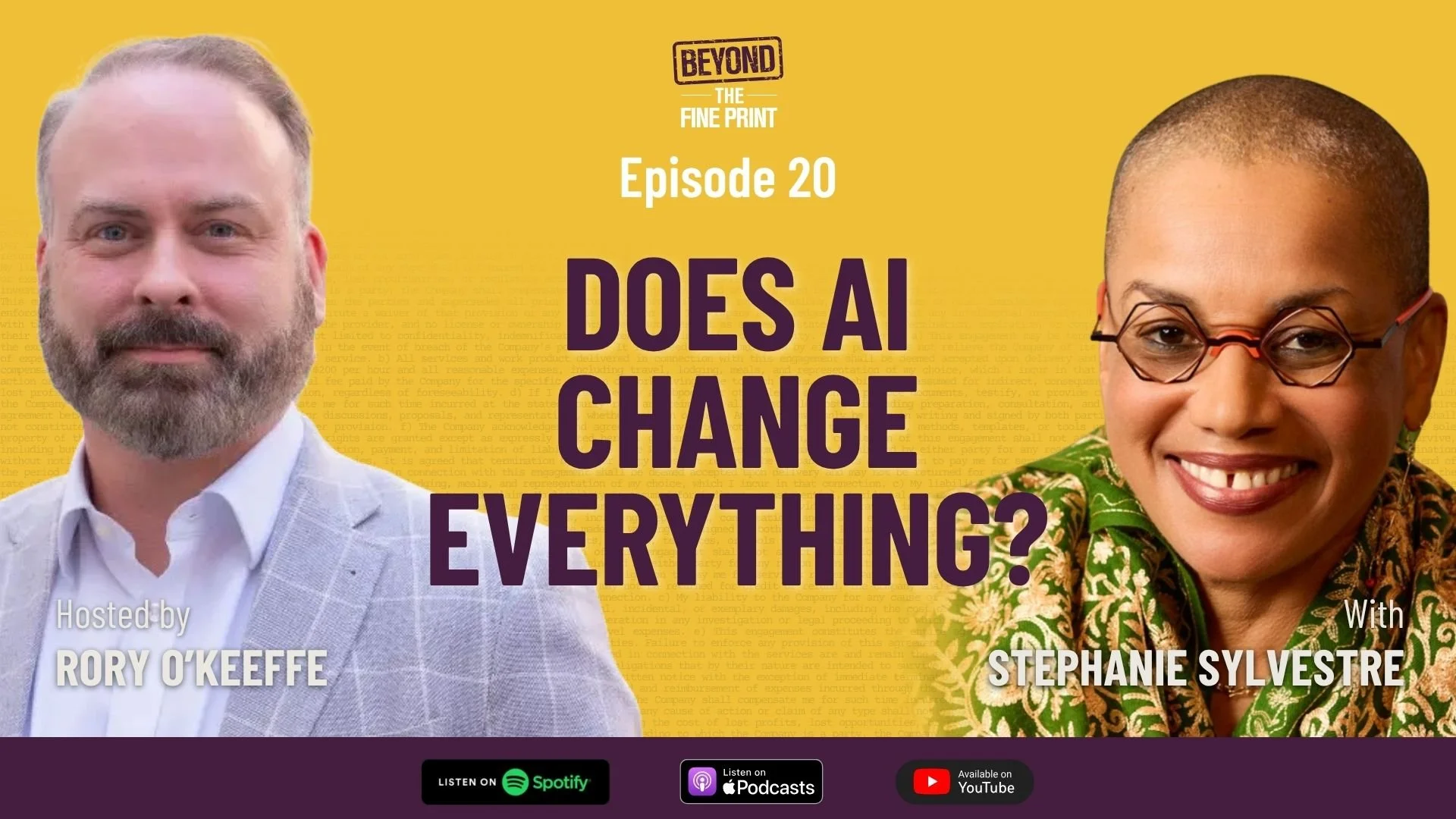
In a conversation with Stephanie Sylvestre - co-founder of Avatar Buddy and Harvard Advanced Leadership Initiative Fellow - we pulled back the curtain on AI in the legal profession. Not the hype version. The real one.
There is a story, perhaps you know it, about a girl who walks a very long road to reach the most powerful figure in the land. When she finally gets behind the curtain, it turns out the great and powerful wizard is just a man with a microphone and a light show.
The legal profession has a curtain problem.
For decades, the complexity of law has been its own velvet rope. Not because the law is unknowable, but because the profession built an economy around making it feel that way. The jargon. The six-minute billing increments. The quiet assumption that someone with seven years of training and a mahogany bookshelf is the only person qualified to interpret a contract.
It was brilliant gatekeeping. And it worked - right up until technology started pulling back the curtain.
That disruptor, increasingly, is AI.
In a recent episode of Beyond The Fine Print, I spoke with Stephanie Sylvestre. Stephanie is a TEDx speaker, a technology leader with over 30 years of experience across brands like Burger King, Subway, and HP, and the co-founder of Avatar Buddy. She is not a lawyer. For the purposes of this conversation, that is exactly the point.
Here are the four core realities shaping the future of legal work.
1. Complexity Doesn’t Require a Priest
AI does not challenge the inherent complexity of the law; it challenges the assumption that navigating complexity requires an expensive intermediary.
Stephanie was clear on this from the start: for straightforward tasks, a properly configured AI agent is already highly capable. It can help a user navigate a lease, interpret a standard clause, or decode legalese they would otherwise have to pay a human to explain. The complexity barrier that once reserved legal insight exclusively for the wealthy is crumbling.
But context matters enormously. Stephanie was equally clear about what AI cannot do:
"You would not ask an unsupervised fifteen-year-old with no legal training to defend you in court. The same logic applies to generic AI."
A standard large language model (LLM) is not a legal tool. It will agree with you even when you are wrong, confuse confidence with accuracy, and hallucinate with total conviction.
The takeaway for lawyers: The professionals who thrive tomorrow will not be those coasting on information scarcity. They will be the experts who trade on actual value. AI will simply accelerate the death of the billable hour - the only pricing model where getting better and faster at your job actively makes you less money.
2. AI Agents vs. Agentic AI: A Critical Governance Distinction
For in-house legal teams, the distinction between an AI agent and agentic AI is not semantic. It is a massive legal and governance question.
AI Agents (Task-Oriented): Software configured to perform a specific task the way a human would, consistently and repeatably (e.g., month-end financial analysis, initial NDA drafting, client intake). You define the process; the AI executes; a human reviews. This is a high-value, low-risk tool.
Agentic AI (Autonomous): Systems granted access to your tech stack, data, and pipelines, and authorized to take action without stepwise human approval. It can place orders, move money, screen candidates, or send external communications entirely out of the loop.
Stephanie’s view on the latter was unambiguous: Agentic AI is not ready for prime time.
This isn't because the technology lacks the capability, but because the governance infrastructure to make it safe does not yet exist. The legal exposure under existing frameworks - consumer protection, product liability, negligence, and data privacy - is already severe, long before any new AI-specific regulations take effect.
If you are being pitched autonomous legal solutions right now, ask this threshold question: Is this an AI agent performing a defined task with human review, or is this agentic AI acting as an autonomous actor? The first has genuine value; the second carries unpriced risk.
3. Bespoke Over Generic: The Power of the "Digital Twin"
A generic LLM is trained on the open internet. It knows a great deal about a great many things, but nothing about your specific practice, your cases, your clients, or your professional judgment.
A boutique legal AI, by contrast, is trained on your data: your past contracts, your legal positions, and your institutional knowledge. It cites its sources, allowing you to click through and verify the underlying documents. It produces outputs that reflect your standards, not a statistical average of Reddit and Wikipedia.
This is the space Avatar Buddy inhabits. Stephanie described a use case where a lawyer built a "digital twin" of himself to handle initial client inquiries. The AI doesn't replace the lawyer; it extends his reach. It asks the right intake questions, gathers the facts, and strips away the jargon. By the time the human-to-human conversation begins, both parties are already speaking the same language.
Crucially, when building this tool, they deliberately stopped iterating at 80% to 85% accuracy. Why? Because it is close enough to be incredibly useful, but distinct enough never to be mistaken for a human. That is what responsible AI looks like in practice: an intentional design choice that protects users, rather than a compliance checkbox.
4. Responsible AI is a Philosophy, Not a Marketing Claim
Stephanie started Avatar Buddy with five psychologists and one developer. That ratio tells a story.
If AI is a social construct - which she argues it is - then building it requires more than just software engineering. It requires a deep understanding of human cognition, behavioral psychology, and how people can be marginalised by rigid systems.
Having deployed tools across Miami, Belize, Ghana, and SouthAfrica, her team ensured that the technology reflected the specific communities it served. Data privacy wasn't bolted on later; it was baked into the architecture from day one.
For organizations implementing AI within their legal functions, this framework is essential. The question cannot just be: Can we build this? It must also be: Who does this serve, how might it fail them, and do we have the right people in the room to answer those questions honestly before we launch?
What This Means for Your Legal Function
Before you close this article, here is one actionable challenge:
Find one tool, workflow, or process in your legal department that exists purely because "that's the way we've always done it." It might be the contract template that hasn't been updated since 2019, an intake process that requires three emails instead of a five-minute form, or a billing structure that rewards friction over efficiency.
Your clients are already looking behind the curtain, and the next generation of talent will not accept complexity as a feature when it is clearly a failure.
Pull back the curtain. The real power was always in the shoes.
This article is based on a conversation with Stephanie Sylvestre, co-founder of Avatar Buddy, featured on Beyond The Fine Print podcast. Listen to the full episode on Spotify, Apple Podcasts, Amazon Prime and YouTube.
Avatar Buddy: avatarbuddy.co
Stephanie Sylvestre on LinkedIn: linkedin.com/in/stephanie-a-sylvestre
Host: Rory O'Keeffe, SRA-regulated solicitor (No. 8008227), SCL-accredited IT lawyer, former Director of Legal at Accenture, 150+ transactions closed.