What Happens When You Sign Without Reading: The Commercial Consequences of Unreviewed Contracts
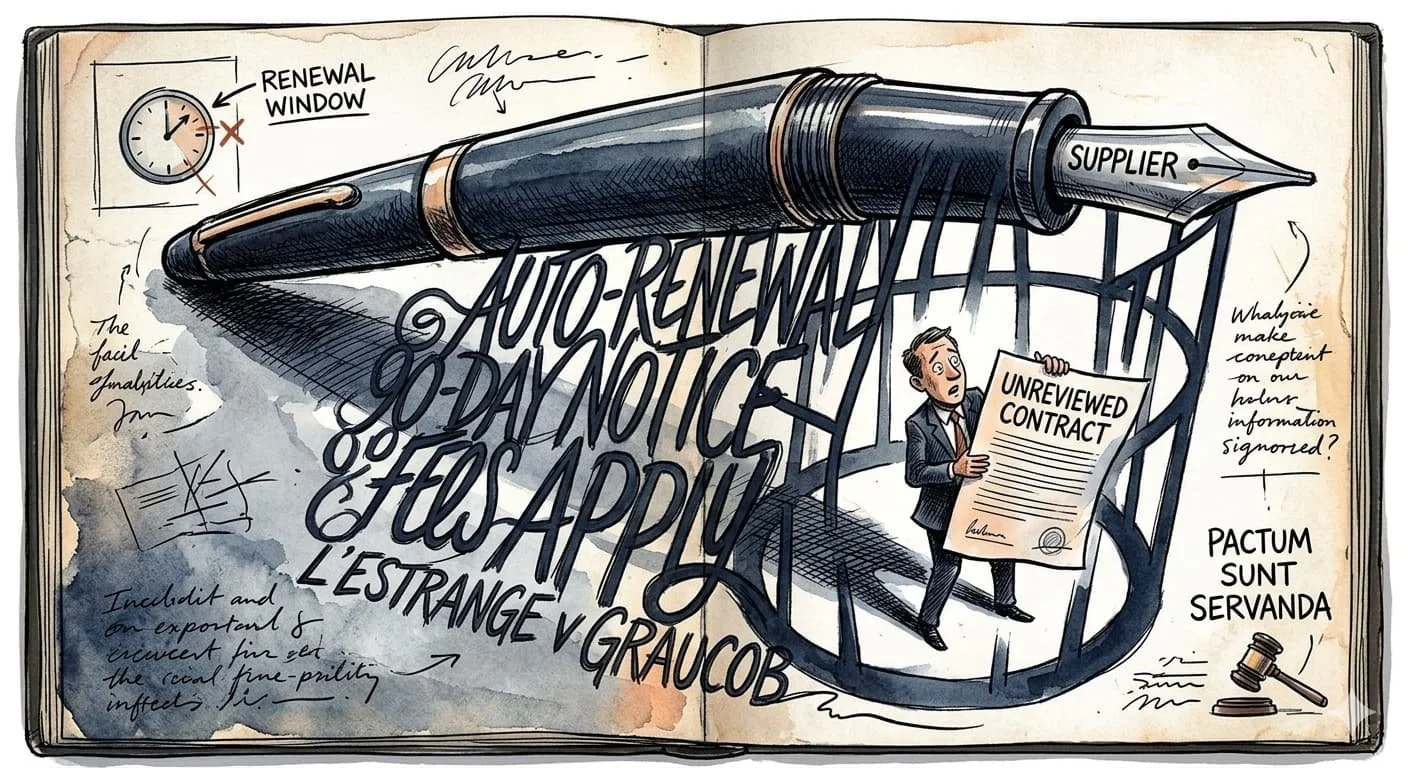
Ah, the modern ritual of the Terms and Conditions — clicked with the breezy confidence of a lottery winner buying a yacht, despite knowing, deep in our mammalian souls, that we have just signed away our firstborn child to a tech conglomerate in Cupertino.
Let us start with an admission. Almost everyone has signed a contract without reading it properly. Sometimes it is the iTunes agreement; sometimes it is a seven-figure supplier contract that actually, as it turns out, mattered a great deal.
If you have signed something that is currently keeping you awake at 3:00 AM, this article is for you. Not a lecture. Not a wagging finger from a disapproving lawyer. A cold, clear map of the legal landscape: what the law says, where the escape hatches are, and exactly when the window of opportunity slams shut.
1. The Uncomfortable Truth: Latin, Loopholes, and the 10:00 PM Surrender
English contract law possesses a certain magnificent, unyielding cruelty. It does not care that you were tired. It does not care that the font size required an electron microscope.
At the very bedrock of our commercial law sits the Latin principle of pacta sunt servanda — agreements must be kept. It applies to contracts you found onerous, contracts you found baffling, and contracts you signed at 10:00 PM on the final day of the financial quarter under immense, sweaty pressure from a hyperactive sales team.
The House of Lords laid down the law on this rather brutally in the 1934 case of L'Estrange v Graucob. Ms. L'Estrange bought a cigarette vending machine and signed a form without reading it. The machine was an absolute piece of junk, but the contract contained a clause excluding all warranties. The court essentially said: "You signed it. You are bound by it. Good day to you." Nothing in the subsequent 90-odd years has dislodged this position.
You signed it. You own it. Now let's find the crowbars.2. The Nuance: Clauses the Law Flatly Refuses to Enforce
This is where the legal architecture becomes vastly more accommodating. Just because a supplier puts a clause in their contract does not mean a British judge will actually let them use it.
Enter the Unfair Contract Terms Act 1977 (UCTA). Under Section 11, if you have contracted on the supplier's standard, take-it-or-leave-it written terms, any clause attempting to exclude or restrict liability for breach of contract or negligence must pass a statutory reasonableness test.
If a supplier tries to cap their liability for destroying your entire database at £500, that clause is highly vulnerable. Separately, for everyday consumer deals, the Consumer Rights Act 2015 provides a sturdy shield, while in B2B contexts, the Supply of Goods and Services Act 1982 firmly implies that services must be carried out with reasonable care and skill. You cannot simply contract out of being competent.
3. Misrepresentation: The Art of the Sales Pitch vs. The Cold Reality
What happens if you were flat-out misled? If a smooth-talking salesperson induced you to sign on the dotted line by making a false statement of fact, the Misrepresentation Act 1967 becomes your best friend. A successful claim can result in rescission — legally hitting the 'undo' button on the entire contract — or substantial damages.
The catch? It must be a false statement of fact, not mere opinion or corporate puffery. "Our software is a glorious triumph of human engineering!" is an opinion. "Our software complies with the EU AI Act and integrates natively with your CRM without custom coding" is a statement of fact.
The BigLaw Defensive Wall. Suppliers know this, so they insert "Entire Agreement" and "Non-Reliance" clauses — paragraphs designed to make you state, in writing, that you didn't believe a single word the salesperson said before signing. English courts view these clauses with immense scepticism if they look like a cynical attempt to sanitise a lie.
What About Duress?
Let us manage expectations. True legal duress is vanishingly rare in business. True duress means someone put a metaphorical gun to your head. Standard commercial pressure — a tight deadline, a take-it-or-leave-it price, or a threat to walk away from a deal you desperately need — is just capitalism, not a legal defence.
4. The Silent Killer: The Clause That Actually Ruins Businesses
In twenty years of reviewing commercial agreements, the provision that causes the most financial devastation is not the liability cap. It is the automatic renewal clause.
Many vendors treat this as a deliberate commercial strategy. Miss the non-renewal notice window by twelve minutes, and you are automatically on the hook for another year or two of a service you no longer want.
Don't wait for a supplier failure to find out what you agreed to at 10:00 PM on a Tuesday.
This article is intended for general wit, wisdom, and educational context only. It does not constitute formal legal advice. RMOK Legal is authorised, and its consultants regulated, by the Solicitors Regulation Authority (SRA No. 8008227).
Author - Rory O’Keeffe: In over 20 years of commercial legal practice - at Matheson, at Accenture, and at RMOK Legal - I have reviewed contracts signed under pressure, contracts signed without being read, and contracts whose consequences only became clear 18 months later when a liability cap was tested or a renewal window was missed. The legal analysis in this article is grounded in that experience. The automatic renewal clause section in particular reflects what I have seen cause the most financial damage across clients at every stage of growth. Rory O'Keeffe, SRA-regulated solicitor (No. 8008227), SCL-accredited IT lawyer, former Director of Legal at Accenture, 150+ transactions closed.