

The Flight of the Autonomous Agent: What London Tech Week Tells Us About Britain's AI Moment
There is a particular kind of buzzword that you hear at technology conferences. It travels in packs, wears a lanyard, and never pays for its own flat white.
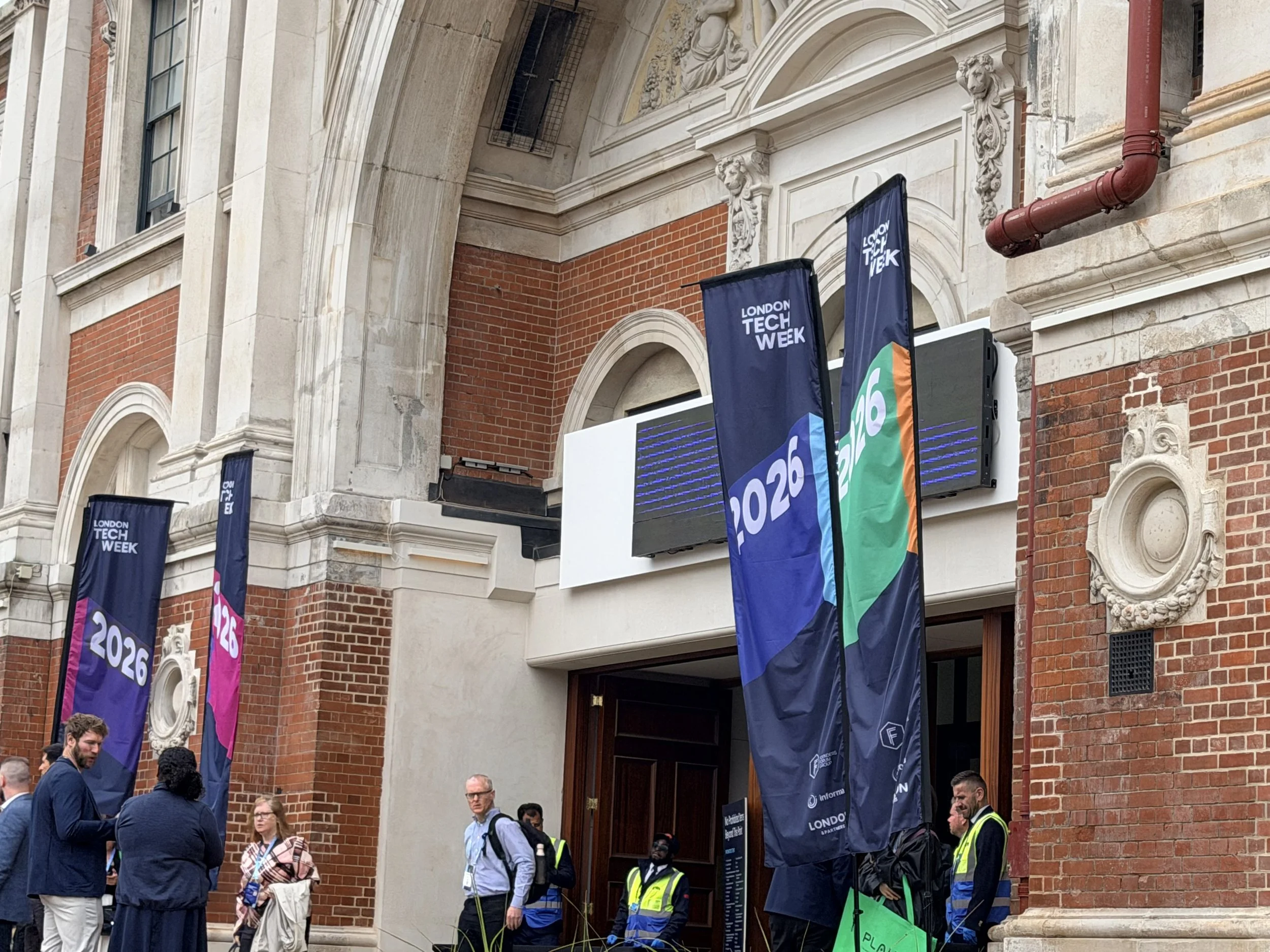
This week, at London Tech Week 2026, it arrived at Olympia London with a freshly updated passport. For years, the tech sector wanted to be your "Disruptor." Then, it wanted to be your "Platform." Then let’s all “Pivot"“. Recently, it desperately wanted to be your "Co-pilot" -- a charming aviation metaphor that implied you were both in the cockpit, wearing aviator sunglasses, steering the corporate enterprise toward sunny horizons. But this year, the co-pilot has been quietly asked to leave the flight deck. We are told the plane can now fly itself. We are less clear on who explains that to the passengers.
Today, we are in the Era of the Agent. We have gone from aviation to travel management. From cockpit drama to expense policy.
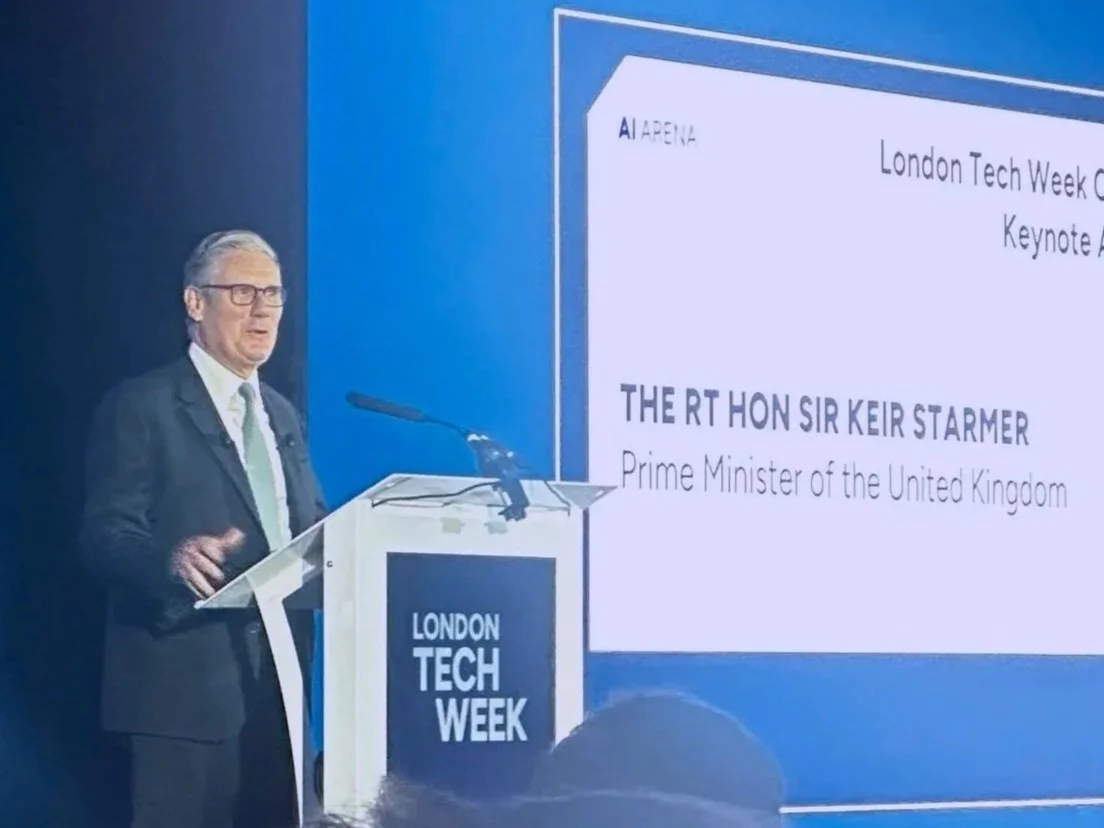
In plain terms, agentic AI moves from tools that respond to prompts to systems that pursue objectives. It is a profound shift, and walking through Olympia, you could feel a bit of the old electricity. The Prime Minister opened proceedings with the kind of speech that made you feel, just for a moment, that Britain might actually be serious this time. "The question is whether we shape this change or allow it to shape us," he told the assembled faithful - - a sentence that sounds deeply philosophical until you realise it applies equally to AI governance, macroeconomic policy, and choosing whether or not to open a packet of biscuits at midnight.
And the ambition was not just hot air. There is a £400 million commitment to sovereign AI compute, a national infrastructure programme, and global giants like AMD doubling down on UK tech. Seeing Dr Lisa Su, one of the most consequential minds in global technology, on stage at Olympia is a genuine win. These are real milestones in a real economy, and they deserve a proper round of applause.
Consider the applause delivered. Now, let us look at the flight plan versus reality.




The Auto-Pilot Delusion
Here is a sentence you are highly likely to read in a breathless corporate press release this month:
"We are deploying autonomous agentic ecosystems to orchestrate hyper-scaled value chains and cross-functional synergy."
If you read that slowly, you realise nothing actually happened. It sounds incredibly busy, in the way a toddler with a saucepan sounds like a chef. But it had all the right words in it, which means it probably made a slide deck somewhere.
The tech industry loves these transitions because they imply a grand journey when we might just be rearranging the overhead lockers. The current darling, Agentic AI, is fundamentally the idea that instead of holding the AI's hand through every step, you give it a destination and let it figure out the route. The agents plan, reason, act, and hand off tasks to other software agents. They behave like a brilliantly efficient junior employee -- the kind who never asks for feedback, has no concept of annual leave, and crucially, never looks at you with judging eyes when you order a third double espresso before 10am (not me, of course!).
The legal industry is, as ever, watching this with a mixture of professional fascination and the specific anxiety of a guild that has spent five centuries building a very deep moat, only to find the water level dropping.
What the Agents Are Actually Doing (So Far) in Law
Let us be honest about the reality on the ground, because honesty is something clients are allegedly paying us for.
Agentic AI in legal services is, in 2026, genuinely impressive -- provided you look at a very specific, narrow sandbox. Document review, contract comparison, due diligence compilation, and billing narrative generation. These are real, useful, time-saving applications. That sounds dramatic, until you see where the deployments actually live: the back office of a law firm made faster, crisper, and significantly cheaper.
What they are not is legal judgment.
An algorithm cannot handle the conversation with a terrified founder at 10pm on a Thursday when a predatory term sheet arrives. It cannot read the room during a tense multi-party negotiation. It does not have the human instinct that tells an experienced partner that the other side's sudden silence on a specific indemnity clause is far more dangerous than anything they have actually said out loud.
But the real disruption here is not that AI replaces lawyers. It is that it reshapes what clients value enough to pay for.
Thomson Reuters reported earlier this year that 15% of professional services organisations have adopted some form of agentic AI, with a further 53% actively planning for it. If the mechanics of document review and contract drafting become autonomous commodity tasks, the billable hour model collapses. The value shifts entirely from the production of legal artefacts to the wisdom of legal advice. The autonomous agents are, for now, just handling the digital photocopying. But in doing so, they are forcing the profession to confront what it is actually worth when the busywork is stripped away.
Britain: Leading or Learning?
This is the tension the Prime Minister's speech danced around without quite landing on.
The opening day of London Tech Week reflected a noticeable shift from possibility to deployment. That sounds mature. But there is a more candid way to frame that transition: the UK spent several years loudly declaring it would lead the global AI revolution, and we are now entering the slightly less glamorous phase of realising we need to execute rapidly to catch up to economies that have been deploying at scale while we were writing white papers.
Look at the data. Around 28% of UK businesses using AI say they are focusing on retraining staff rather than cutting jobs. Statistically speaking, that is less than a third. Meanwhile, 17% expect AI to reduce their workforce during 2026.
The Prime Minister spoke warmly about wanting the benefits of this revolution felt in every community -- imagining AI tutors for children on free school meals and new job search tools. It is a noble vision. It is also, you might notice, a world away from the conversation happening on the main stages at Olympia, which is primarily about enterprise productivity, infrastructure returns, and the compounding profits that flow straight to capital.
The gap between the political language of inclusion and the commercial reality of corporate efficiency is as old as the steam engine. The question for this government is whether they have the policy levers to bridge it, or whether the rhetoric is doing the heavy lifting on its own.

The Accountability Arbitrage
Having spent years advising on technology contracts at a scale where the commas in the numbers have commas of their own, I have developed a hypersensitivity to the gap between what a software vendor promises and what the contract actually guarantees.
The enterprise tech ecosystem has built extraordinary margins on this exact gap. And for lawyers, the agentic story contains a beautiful irony. The legal profession exists entirely to manage risk, allocate liability, and hold parties to their word. We are now being asked to warmly embrace a class of technology that is, by its very architecture, non-deterministic and remarkably difficult to hold accountable for anything.
Who is responsible when an autonomous AI agent drafts a clause that accidentally creates a multi-million-pound liability? Who owns the error when an agentic system reviews three hundred cross-border contracts and misses the change-of-control provision that ruins the acquisition?
The technology vendors have read the room, looked at the liability frameworks, and helpfully decided who is flying the plane when things go wrong. Their terms remain remarkably clear: we provide the capability; you retain the consequences.
This is not a reason to lock the door and pretend the technology does not exist. It is a reason to read the fine print before you press Go.
The UK has a fascinating opportunity here. If Britain can build a regulatory framework that enables deployment without outsourcing all the risk to the end-users least equipped to bear it, that is a global competitive advantage. The EU AI Act is grinding into gear, and global governance frameworks are being drafted. The question of what an AI agent can do without a human in the loop is no longer an abstract philosophical debate. It is a commercial, contractual, and insurance question that someone is going to have to sign off on, in ink.
To a lawyer, that is not a barrier. That is an invitation.
What to Actually Watch For
London Tech Week is a useful annual temperature check. Not because the corporate announcements are always entirely real, but because the language is. The words people choose to embrace -- and the ones they suddenly stop using -- tell you exactly where the money is going.
This year, the mood is one of purposeful pragmatism. The wild-eyed hype of the early generative AI era has been replaced by talks on infrastructure, data pipelines, and adoption curves. The Prime Minister talked about NHS waiting lists; Dr Lisa Su talked about solving actual enterprise bottlenecks. Even the venture capitalists have stopped talking about infinite valuations and started asking about practical unit economics.
This is healthy. It means the technology is finally being tested against the friction of reality rather than the smoothness of a PowerPoint presentation.
Whether the UK is genuinely leading this race or simply running very fast to stay in the pack is a question we will have to ask again in twelve months. In the meantime, keep your eyes on the metaphors. When a vendor promises that their new autonomous agent will completely reinvent or take care of your business, ask them exactly what the agent costs, who takes the blame when it hallucinates a regulatory filing, and whether the humans whose jobs it touches had any say in its training.
The tools have changed. The questions have not. And the people who know which questions to ask are still the ones in control.
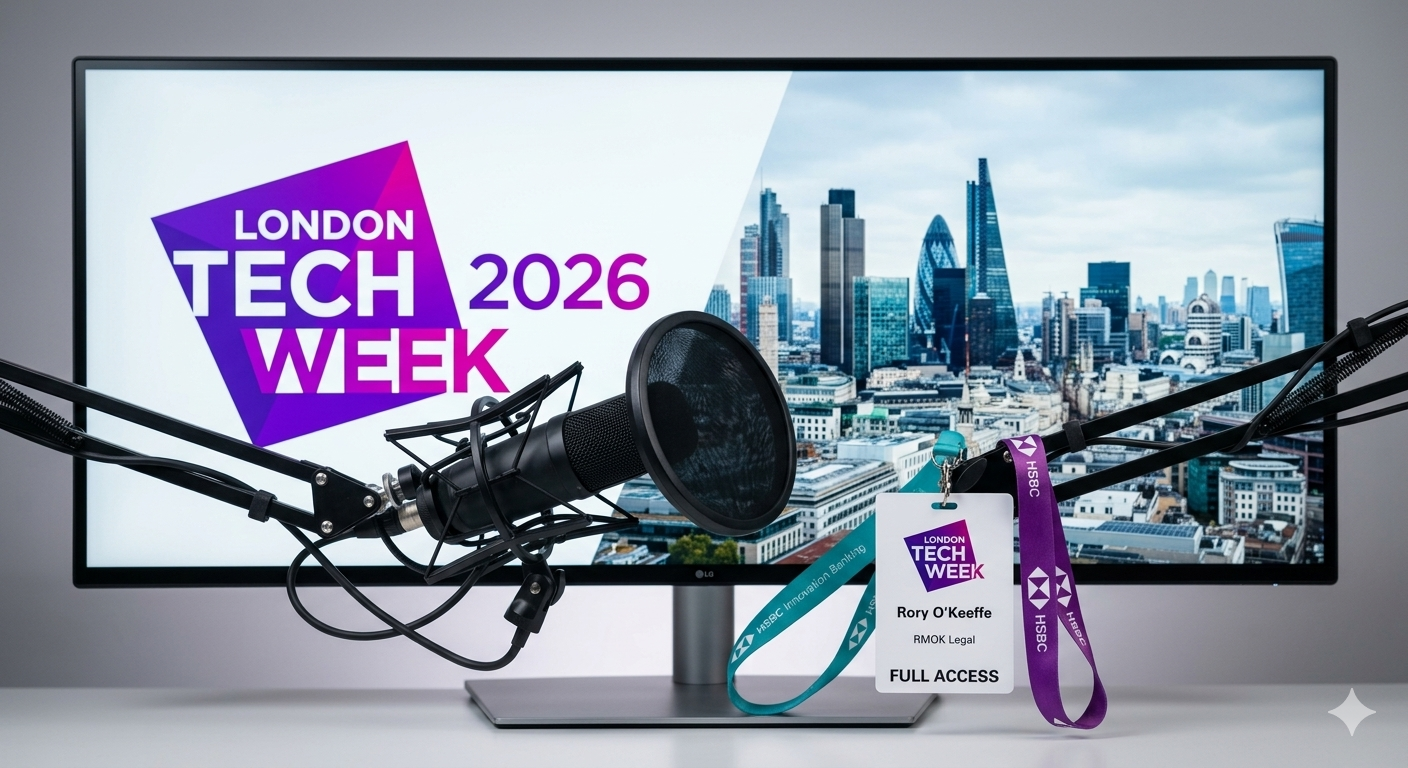
Author: Rory O'Keeffe is a solicitor, SCL-accredited Leading IT Lawyer, and founder of RMOK Legal. He advises technology companies, scaling businesses, and in-house legal teams on commercial contracts, AI governance, and the legal infrastructure that makes growth possible without creating the kind of surprises that end up in court. His podcast, Beyond The Fine Print, is available on Spotify, Apple Podcasts, and YouTube.
Subscribe to the Beyond The Fine Print newsletter: https://www.linkedin.com/newsletters/beyond-the-fine-print-7454946749858869264/