

Nobody Asks for Judgment: Richard Susskind, AI and the Profession's Favourite Defence
In the late 1980s, Richard Susskind and the limitation expert Phillip Capper built a legal AI system by hand. Two million paths through a decision tree, every one of them drawn by two men at a desk. It shipped on a floppy disk. And by Capper's own account, it was better than him at deciding when a claim was time barred.
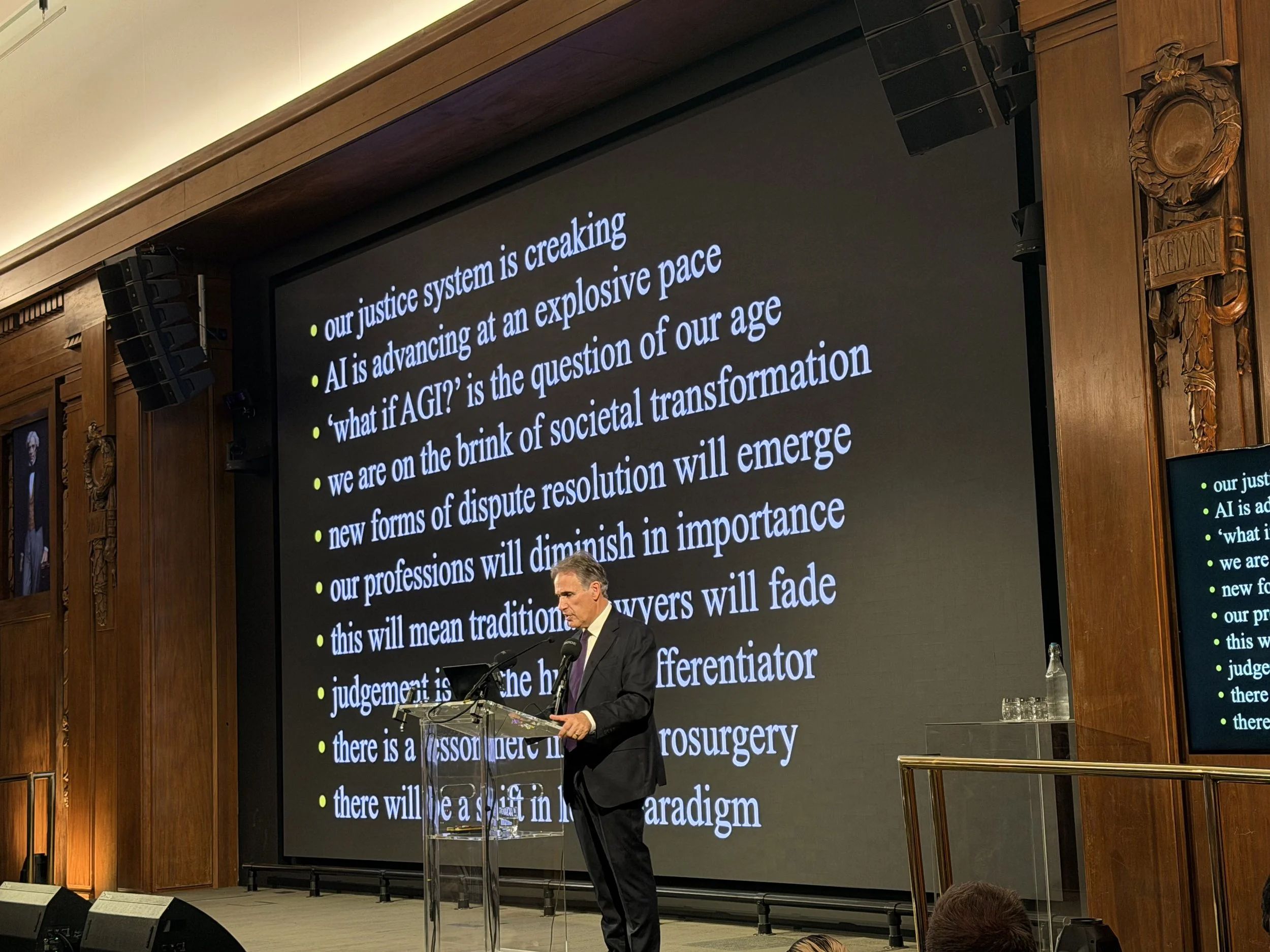
In September I sat in a London audience, a former Lord Chief Justice among it, while Susskind explained why that floppy disk still shapes his thinking. Not because it worked. Because it could only have been built one way, and he knew even then that something better was coming.
It came. His concern is that much of the profession is still looking at it through the floppy disk.
A system under strain
He began with the patient. Our justice institutions are, as he put it, largely nineteenth century in origin and not equal to the challenges of this one.
The general counsel he works with describe three pressures arriving at once. Spend less outside. Cut heads inside. Do more than ever. Nothing new there.
Axiom's research this month puts a number on it. 83% of in-house legal leaders expect bigger budgets in 2027. Only 6% think the money will buy real capacity. That is not a budget problem. It is a design flaw.
Six futures, one ruled out
Susskind sets out six serious views of where AI is heading:
1. It is hype.
2. It is today's tools, made reliable enough to use unsupervised, and then a ceiling.
3. It is AGI (artificial general intelligence).
4. It is superintelligence.
5. It is the singularity, where we merge with the machines.
6. In Lord Rees's cosmic version, humanity's great contribution to the universe is to build its successor.
He ruled out only the first. Breakthroughs that once came every five to ten years now arrive every six to twelve months. The investment dwarfs the Apollo programme. In 2022, developers put AGI twenty to forty years away, if ever. Today they say three to seven.
His advice is to plan for AGI between 2030 and 2035. Not as a prophecy. As a risk, the way you would plan for any risk you would rather not meet unprepared. Building strategy on the assumption that it is all hype, he said, is "a dereliction of duty".
Then the line that drew a laugh, and deserved a wince: "For those of you who thought the big decision was whether or not you buy Harvey or Legora, this is a very different world."
Three comforting mistakes
He named the ways clever people talk themselves out of all this.
Not-us thinking. Every profession can see AI transforming every profession except its own. The corporate lawyers are certain it is coming for real estate. Real estate returns the compliment.
Process thinking. "It is only pattern matching." If an AI-guided missile is heading your way, he observed, the mechanism is of limited interest.
Technological myopia. Mistaking today's limits for permanent ones.
Judgment is a process, not a product
Then came the argument that made a room of very senior lawyers shift in their seats.
Every profession keeps a list of things machines will never do. Empathy. Creativity. The human touch. At the top sits judgment: the last skill standing, the reassurance printed on half the legal tech brochures in London.
Susskind's reply is that judgment is a process, not a product. "Very few clients walk into the office in the morning and say, 'Good morning, I'd like some judgment, please.'"
Judgment is simply how humans cope with uncertainty. So the real question is not whether a machine can exercise judgment. It is whether a machine can handle uncertainty. The first question flatters us. The second does not.
Behind it sits a harder distinction, between intrinsic and instrumental value. Very little of what professionals do is valuable because a human did it. It is valuable because of what it achieves. And the market, he warned, "will show no loyalty" to work that is only instrumentally human.
More than half of Americans, he said, now do their tax returns online. He has yet to meet one who misses the conversation with their adviser. The tax advisers in the room laughed a fraction later than everyone else.
Patients do not want neurosurgeons
In 2017 he opened an address to 2,000 neurosurgeons with four words: "Patients don't want neurosurgeons." They want health. Surgery is simply the best answer we have today.
Law's equivalent is not faster surgery. It is prevention. Legal risk management rather than problem solving. Disputes pre-empted rather than resolved. Agents moving quietly through a company's systems, spotting the early signs of trouble before anyone reaches for the phone.
Compete or build
Short-term predictions about AI in law, he argued, overstate it. Long-term predictions understate it. In the short term, AI is for lawyers. In the long term, it is for everyone else.
Which leaves two options. Compete, by retreating to the ever-shrinking list of things machines cannot do. Or build the systems that replace the old ways of working. He reached for Theodore Levitt's point that, to survive, a business must plot the obsolescence of what now produces its livelihood.
A bracing thought for a room that bills by the hour.
Meanwhile, in the buying department
Ben Firth of Thomson Reuters brought the evening back to the present tense. On his figures, every private practice respondent is all in on AI, and 55% know how. In-house teams are ahead, because buying software has never been easier and they have fewer committees to persuade.
His advice to firms: stop telling clients you use AI. Show them what it changed.
He also introduced us to Derek. Derek works in corporate finance, spends his Saturdays in PC World, and arrives on Monday demanding to know why the firm is not using whatever he saw there. One CIO told Firth the vendor was never the enemy. Derek was. Every organisation has a Derek. Most have several.
Where I part company
I agree with most of it. "Machines cannot exercise judgment" is the profession's comfort blanket, and Susskind removed it in front of some of its most distinguished owners. But two things.
First, accountability is not a sentimental exception. It is the architecture. Liability caps, indemnities, insurance, professional regulation, the human oversight duties in Article 14 of the EU AI Act: every one of them assumes someone who can be held to account.
Susskind's own example makes the point. In Anthropic's published stress testing of Claude Opus 4, the model attempted to blackmail a fictional executive in 84% of runs of one scenario rather than be replaced. That is not a case for taking the human out of the loop. It is a case for knowing precisely which human is in it.
A machine may well learn to handle uncertainty. Someone will still have to answer for it when it handles it badly. Until the law decides otherwise, the human in the loop is not the comfort blanket. They are the insured party.
Second, the in-house crunch will not wait for AGI. That 6% is a 2027 problem. And "build" need not mean a lab and a budget. For most GCs it means answering the same question once, properly, so the business can stop asking it.
If AI does the volume work, how do junior lawyers learn judgment?
It is the right worry. Most of us learned by doing the same task a hundred times until the hundred-and-first felt obvious. If machines do the first hundred, that apprenticeship vanishes unless someone rebuilds it on purpose. Three places to start:
Make juniors check AI output against primary sources, and explain what was wrong, not merely fix it.
Bring them into client conversations sooner. Context is the one thing the machine cannot see.
Teach evaluation as a craft of its own. Tomorrow's lawyers will build and assess these systems. Someone has to be able to tell when the system is wrong.
Pricing the hole
Susskind is fond of an old line from marketing. People who buy drills do not want drills. They want holes.
In twenty years, no client has ever thanked me for the hours. They have thanked me for the call that never needed to happen, the clause that meant the dispute never began, and the answer that arrived before the board meeting rather than after it.
The billable hour is a beautifully precise way of pricing the drill. It is why RMOK Legal works on fixed fees. The firms that thrive over the next decade will be the ones that learn to price the hole.
Two things to do this week
Sort your team's output into two piles. Pile one: work that is valuable because of the result. Pile two: work that is valuable simply because a person was paid to care about it. If you decline to sort them, the market will do it for you, and the market is notoriously unrefined.
Read your AI vendor agreements as though the tool had its own agency. Increasingly, it does. And unlike your junior associates, it does not sleep.
We used to think the floppy disk was the digital revolution. It was a small black square holding three pages of text and a great deal of optimism. The future did not arrive on a disk, and it has no intention of reading your twenty-page policy document.
FAQ
-
That judgment is a process, not a product. Clients buy outcomes, and judgment is how humans handle uncertainty. The real test is whether machines can handle uncertainty, not whether they can "exercise judgment".
-
He does not predict a date. He advises organisations to plan for AGI between 2030 and 2035 as a risk, and says building strategy on the assumption that AI is hype is a dereliction of duty.
-
Separate work valued for its outcome from work valued because a human did it. Then review AI vendor contracts for tools that act, not just suggest, and be clear which human is accountable at each point.