

When Harry Met Midlife: What Lawyers Over 40 Are Not Saying Out Loud
There is a film where a man and a woman spend 12 years disagreeing about everything, including themselves. He thinks he is a realist. She thinks she is fine. He delivers bleak monologues about the inevitability of death on a car journey. She orders food with the precision of a contract lawyer and the confidence of someone who has never once questioned a life choice.
If you have ever read a markup from a mid-level associate with 14 conditions attached to a single consent clause, you have met Sally Albright. She just went into catering instead of commercial law.
But both of them are wrong. And somewhere between the first and last arguments, they each quietly dismantle the version of themselves they built in their 20s and discover that the person they are pretending to be is getting in the way of the person they actually want to become.
So if you are a lawyer or a business leader somewhere north of 40, and you have recently caught yourself staring out a window during a Teams call thinking "is this it?", congratulations. You are finally having the conversation Harry and Sally spent 12 years avoiding.
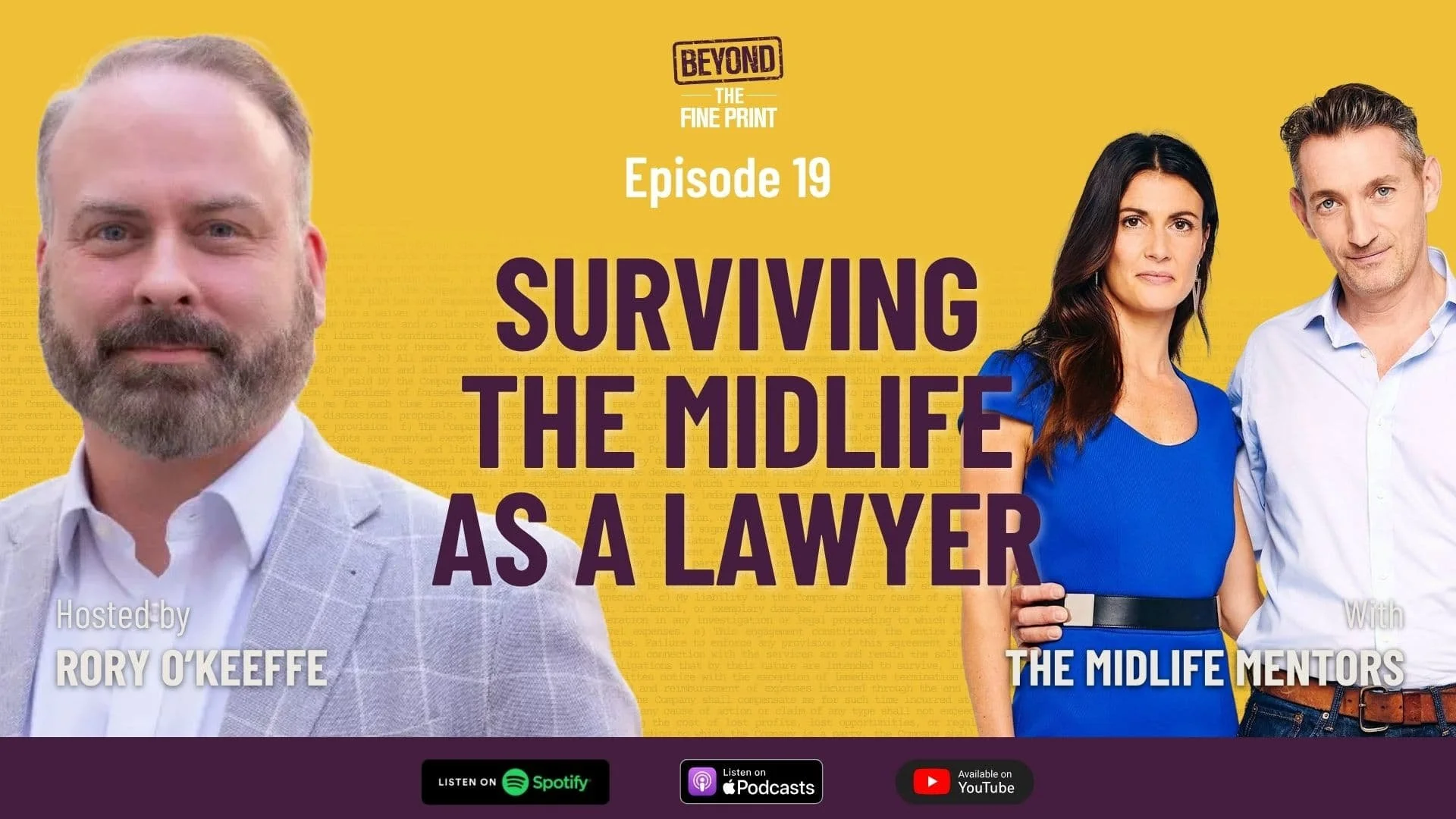
This episode of Beyond The Fine Print features James and Claire Davis, co-founders of The Midlife Mentors, whose podcast sits in the top 1.5% globally. James is the author of The Midlife Male Handbook. Claire is a stress management consultant, qualified menopause practitioner, and executive coach. They are both certified by the International Menopause Society, both work with corporates on wellbeing, resilience, and performance, and both went through divorce before finding each other. They have not just studied midlife reinvention. They have lived it.
If Harry and Sally had met James and Claire 10 years earlier, the film would have been a lot shorter and significantly less stressful.
It Is Not a Crisis. It Is a Contemplation.
James and Claire distinguish between a midlife crisis, which implies something has broken, and a midlife contemplation, which means something is finally being examined.
Their observation is that the feeling tends to arrive from one of two directions. Either "I am not where I thought I would be, and there is a quiet disappointment" or "I am exactly where I thought I would be, and it is not what I thought it would feel like." Flip sides of the same coin.
The cause, they argue, is that people set their values and direction in their 20s, and then never go back and check. Life experience changes what matters to you, but if you never revisit the original compass, you end up living out of alignment with who you have actually become. That misalignment shows up at midlife because, for many professionals, it is the first time the noise stops long enough for the question to be heard.
For the legal profession, this is particularly acute. You may have spent years training to become a lawyer, then a decade of specialisation, and then on a Tuesday afternoon you think: what if I did not actually want to be the leading authority on cross-border supply chain indemnities? And there is nobody to call, because everyone you would call is also a leader in something equally niche.
The Lie You Were Sold About Success
Claire's framing of this was the sharpest moment in the conversation. Society, she argued, operates a kind of slow-motion gaslighting that begins in infant school. Get good grades and you will be happy. Get into university and you will be happy. Get the job, the title, the postcode, and you will be happy. The goalposts keep moving. And the digital age has made it worse: you are now comparing your internal state to everyone else's highlight reel.
The result is what she described as a consumption-validation loop: constantly seeking the next promotion, the next purchase, the next hit of external validation, without ever learning that nothing outside yourself is going to deliver the internal peace you are actually looking for.
This connects directly to what James explained about dopamine. We are all dopamine-seeking by design. The issue is not dopamine itself, but where you are sourcing it. If your primary dopamine hit comes from your phone, from the next promotion, or from the anticipation of things rather than the experience of them, you are running a loop that will never close. The buzz, they explained, is in the anticipation, not the arrival. That is why the promotion feels flat 48 hours after you get it.
Energy Is Not a Character Trait. It Is a Biological Reality.
This was where the conversation moved into territory that most professional environments still handle badly.
For men, testosterone peaks in the 20s and declines steadily. By your 40s and 50s, the symptoms, including weight gain, anxiety, confidence dips, cognitive fog, and reduced energy, are real, but because the decline is gradual, most men chalk it up to overwork and stress.
For women, the perimenopause period involves wildly fluctuating oestrogen levels, which can affect cognition, anxiety, sleep, and stress tolerance. Claire's point was that the hormonal shift also drives a fundamental change in identity: women at this stage often experience a powerful internal recalibration of boundaries and priorities.
The legal profession, I observed, has created a culture that pretends energy is a character trait rather than a biological reality. A female partner who loses focus in a meeting is told she is not engaged. A male general counsel who cannot muster enthusiasm for the quarterly review is told he has checked out. Both might have a physiological component that nobody has given them the space to consider. Getting your levels checked is not a weakness. It is a data point, and in a profession that prides itself on protecting the brain, it is remarkable how little attention we pay to the body that keeps it running.
Claire was clear that HRT and testosterone replacement therapy are not magic solutions on their own. Diet, exercise (particularly resistance training), sleep, and stress management are all controllable lifestyle factors that dramatically affect how you feel. And stress, she noted, has become so normalised in the profession that people wear it as a badge of honour, while cortisol quietly undermines their hormonal balance, energy, and cognitive function.
You Are the Direct Result of Who You Are Right Now
James offered the line that landed hardest: "Who you are right now has created everything you currently have. If you do not change, you keep getting the same results."
For someone who has spent 20 years building a career, compromising, adapting, and becoming what the role or the firm or the family needed them to be, that is a confronting statement. But it is also a liberating one, because it implies the converse: if you change who you are, even in small ways, the results change too.
Their approach is not the dramatic reinvention that Hollywood sells. It is what they call the "future self" exercise: imagine yourself two years from now. What does life look like? What are you wearing? How are you holding yourself? What behaviours did that version of you need to adopt? What beliefs? Then start embodying them today, from the smallest choices. In the queue for coffee, rather than defaulting to habit, ask: what would the version of me I want to become choose in this moment?
Claire's practical addition was blunt: people do not take the time. We set goals for our careers, run return-on-investment analyses, create project plans, and then do absolutely none of that for our personal selves. That is why nothing changes. Put as much effort into yourself as you do into your career. It really is that simple, and that hard.
Retraining the "Negative First" Instinct Without Losing Your Edge
This was the segment I was most interested in, because lawyers are a special case. We are literally trained to find the worst-case scenario and then build a fortress around it. That instinct is professionally valuable. It is also, at midlife, personally corrosive.
James's advice was not to abandon the instinct but to balance it. Five minutes every morning, before you switch on your phone and before you let the outside world in, ask yourself: what is good in my life? What was good about yesterday? What would make today good?
The point is not to become relentlessly positive. It is to build the muscle that counterbalances the one you have been training for 20 years. Gratitude, he noted, is not something humans do naturally. We are fear-based animals designed to look for danger. Lawyers are then trained to do that even more. Building the opposite capacity is not a contradiction. It creates a more balanced, more resilient professional.
Claire added the concept of opportunity cost: if something is bothering you and you are choosing not to address it because change feels risky, what is it costing you to stay where you are? We are excellent at catastrophising about what could go wrong if we try. We almost never calculate the cost of staying stuck.
How to Recognise When You Are Wearing a Mask
James and Claire both spoke about the masks professionals wear: the work mask, the home mask, the friends mask. At midlife, the masks can become so layered that the person underneath genuinely does not know who they are anymore.
Their advice: check whether "I do not have time" is a genuine constraint or a fear response. Often, it is fear dressed up as a scheduling problem. Fear of trying something new, fear of failure, fear of rejection. The clock ticking in the background makes it worse: at midlife, the stakes feel higher, and the tolerance for risk drops. But staying stuck is not the safe option. It is the slow one.
Their strongest practical point was accountability. You do not need to do this alone. Coaches, mentors, peer groups, or even one honest friend who will call you on your excuses. The fairy godmother is not coming. What works is small, consistent, disciplined action, the kind that most professionals are already excellent at applying to everything except themselves.
One Question to Take Away
“If nothing changes in the next 12 months, in your career, your energy, your health, your sense of who you are, will you be okay with that?”
Harry spent 12 years performing certainty, delivering opinions about everything, and understanding nothing about himself. Sally spent the same 12 years performing control, keeping everything tidy, and quietly wondering if it was ever going to be enough. It took a New Year's Eve, a crowded room, and the willingness to say out loud what they had both been thinking silently for a decade.
You do not need the New Year's Eve. You do not need the crowded room. You just need five minutes and one honest question.
It is not a crisis. It is a contemplation. And the person you are going to be for the rest of your life is waiting for you to start.
Key Takeaways
Midlife contemplation is not a crisis. It is the first time many professionals pause long enough to hear a question they have been avoiding.
The feeling of "I have everything I wanted and I have never felt more empty" is as common as "I am not where I thought I would be." Both signal the same misalignment.
Dopamine-seeking is human. The issue is where you source it. If your primary hit comes from external validation, the loop will never close.
Hormonal changes in midlife (declining testosterone for men, fluctuating oestrogen for women) are physiological realities that affect mood, cognition, energy, and confidence. Getting checked is data, not weakness.
HRT and TRT are not magic solutions. Diet, resistance training, sleep, stress management, and boundaries are all controllable factors.
Lawyers are trained to find the worst case. Building a daily gratitude practice is not the opposite of that instinct. It is the counterweight.
"I do not have time" is often fear wearing a diary.
Put as much effort into your personal plan as you do into your career plan. That is the difference between another year of the same and the start of something different.
About the Guests
James Davis is the co-founder of The Midlife Mentors and author of The Midlife Male Handbook. He is certified by the International Menopause Society and works with corporate organisations on wellbeing, resilience, and performance. His focus is on the andropause, identity reinvention, and the psychological challenges facing men at midlife.
Claire Davis is the co-founder of The Midlife Mentors, a stress management consultant, qualified menopause practitioner, and executive coach. She is certified by the International Menopause Society and specialises in helping women navigate the hormonal, psychological, and professional dimensions of perimenopause and menopause. Together, James and Claire host a podcast ranked in the top 1.5% globally.
About the Host
Rory O'Keeffe is the founder of RMOK Legal, a City of London commercial law practice specialising in AI governance, technology contracts, and fractional general counsel services. He is an SCL-accredited Leading IT Lawyer, AI Committee member of the Society for Computers and Law, and author of AI Advantage: Thriving Within Civilisation's Next Big Disruption (2025). He previously served as Partner at Matheson and Director of Legal Services at Accenture.
Listen to this episode: Spotify | Apple Podcasts | YouTube
Subscribe to Beyond The Fine Print (newsletter)