

In-House Legal Operating Models: Key Takeaways from the 2026 LexisNexis Architects of Change Report

What a LexisNexis presentation revealed about the glorious mess of modern in-house law.
Here is a truth that would be funny if it weren't so widespread: the in-house legal team has finally been invited to the grown-ups' table, and it is eating dinner with its hands because nobody thought to give it cutlery.
That, in essence, was the thrust of a presentation by Josh Giddens, Director of Practical Guidance and Executive Sponsor at LexisNexis UK, at this year's Future Lawyer UK (London). And while the phrase "operating models" does not, on first hearing, quicken the pulse, what Giddens actually delivered was something closer to an intervention. A polite, data-backed, very British intervention.
Key Takeaways
The 2026 LexisNexis Architects of Change report, based on interviews with over 1,000 lawyers, confirms what many in-house teams already feel: strategic influence has arrived, but the operating model has not kept pace. 72% of in-house teams are now involved in board-level decisions, yet nearly one in four still describe their role as fundamentally reactive. The most common way business colleagues describe the legal function is "supportive but overstretched," while fewer than 3% see their legal team as innovative, tech-enabled, and integral to the business. Closing that gap requires three structural shifts: from heroic effort to designed delivery, from lawyer-only to blended resourcing, and from bespoke advice to scalable systems. Generative AI matters, but only creates value when embedded inside well-designed workflows, not bolted on as an afterthought.
You Are Important. You Are Also Drowning.
The numbers come from the forthcoming 2026 LexisNexis Thought Leadership Report, Architects of Change, and they paint a portrait that is equal parts flattering and alarming.
72% of the 1,000-plus lawyers surveyed said their legal teams are now involved in board-level decisions. Seventy-two percent. That is not a seat at the table. That is practically a reserved parking space.
But here is where the portrait develops a crack: even among those who have made it into the boardroom, nearly one in four still described their team's day-to-day role as fundamentally reactive. Which is a bit like being promoted to head chef while still being asked to wash the dishes, restock the fridges, and chase the delivery driver down the street.
The show of hands in the room confirmed what the data suggested. More work? Yes. More complexity? Obviously. More expectation, faster turnaround, deeper commerciality? Every hand went up. It was less an audience poll and more a collective exhale.
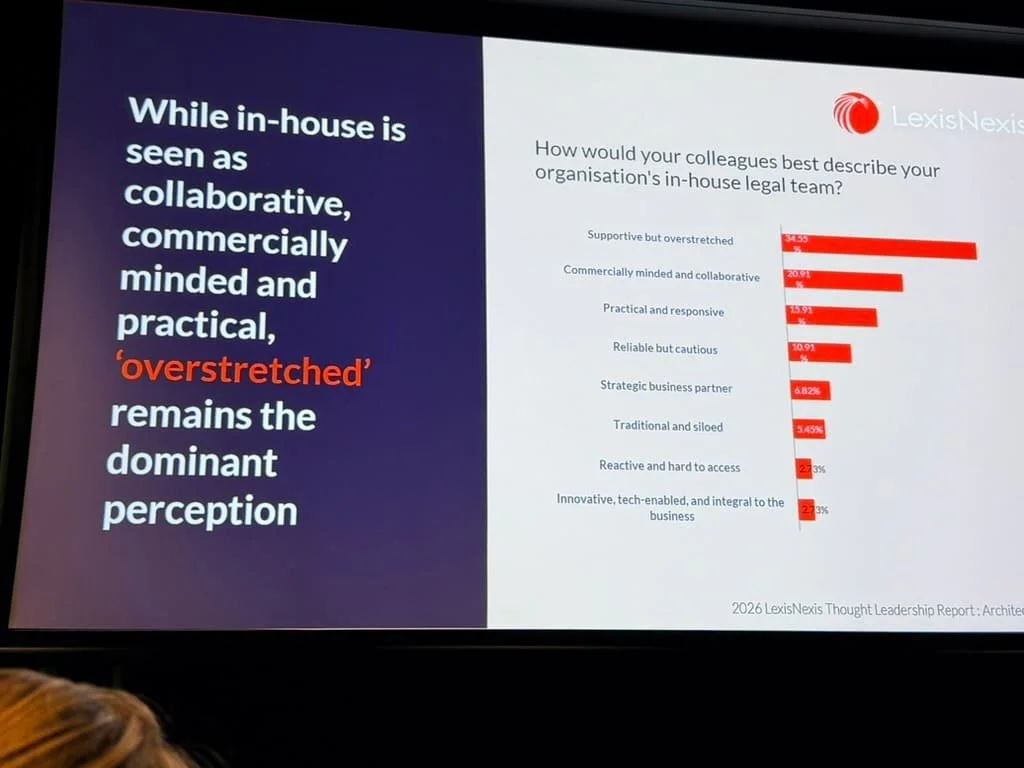
"Supportive But Overstretched": The Five-Star Review Nobody Wanted
When respondents were asked how their business colleagues would describe the in-house legal function, the single most common answer, chosen by over a third, was "supportive but overstretched." Which is corporate-speak for: "We love you. We also know you haven't slept."
Midway down the chart, things look respectable enough: commercially minded, collaborative, practical. Nobody is questioning the talent. But scroll to the very bottom and you find "innovative, tech-enabled, and integral to the business" sitting at under 3%. Three percent. That is not a rounding error. That is a cry for help rendered in bar chart form.
Gidden's observation was sharp: the teams that are overstretched and the teams that have not yet embedded technology and innovation are very likely the same teams. These are not separate problems on parallel tracks. They are the same problem wearing two different hats.
Three Shifts (None of Which Involve Buying a Shiny New Tool)
The heart of the talk was a framework of three shifts that in-house teams need to make. And what made it land was that none of them started with a procurement conversation.
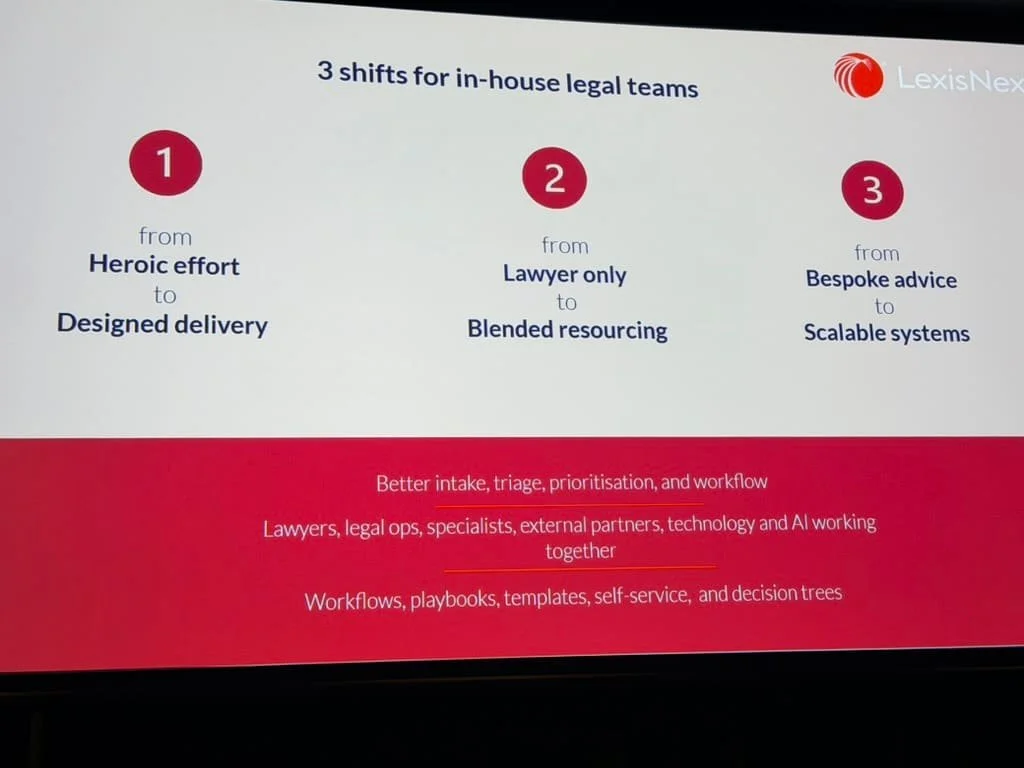
First, from heroic effort to designed delivery. Every legal team has that person. The one who carries the institutional memory, who knows where the bodies are buried (contractually speaking), who somehow keeps the whole thing running through sheer force of will and an alarming caffeine intake. Giddens was diplomatic but direct: that is not a system. It is a dependency. And when that person burns out, takes a holiday, or gets headhunted, the whole model wobbles like a table with three legs. Designed delivery means intake processes, triage, prioritisation, and repeatable workflows, so that quality does not live or die with whoever happens to pick up the phone.
Second, from lawyer-only to blended resourcing. Not every problem needs a qualified solicitor staring at it for three hours. Some do, of course, and you want the best mind in the room for those. But a significant proportion of what lands on legal's desk could be handled through a combination of legal ops professionals, specialists, technology, and well-designed self-service. The trick is routing work by complexity and risk, not by the ancient tradition of "whoever's inbox it landed in first."
Third, from bespoke advice to scalable systems. If the same question keeps arriving like a particularly persistent pigeon, perhaps the answer is not to keep shooing it away individually but to build a scarecrow. Playbooks, templates, decision trees, self-service tools. Most GCs Giddens speaks to estimate that 40 to 60% of their team's work is repeatable. That is an extraordinary amount of senior legal talent being spent on things that could, with a bit of design, largely run themselves.
The AI Slide Everyone Needed to See
In a world where no presentation is complete without at least one mention of generative AI, Giddings did something refreshing: he told the truth about it.
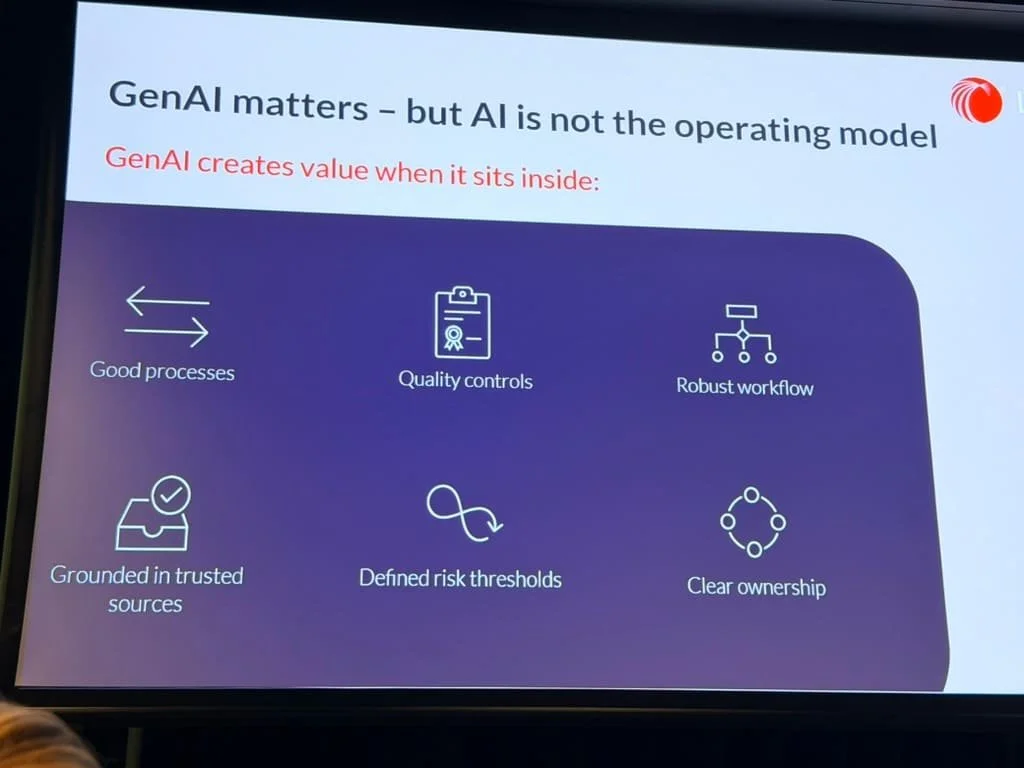
GenAI matters. Nobody is disputing that. It is already reshaping contract review, research, drafting, and knowledge management. But, and this is where the room got quiet, GenAI is not the operating model. It is a component. Drop it into unclear workflows, weak quality controls, and uncertain ownership and you do not get transformation. You get, as Giddings put it, faster inconsistency. Which is rather like giving a sat-nav to someone who does not know where they want to go. You will get there more quickly. You just will not like where you end up.
The teams extracting real value from AI are the ones that did the boring work first: good processes, quality controls, robust workflows, trusted content sources, and clear ownership. AI sits inside that infrastructure. It does not replace it.
The Question That Lingers
Giddens closed with a challenge that deserves more than a passing nod: if you were designing your in-house legal operating model from scratch, built around today's demands rather than inherited from yesterday's, what would you change?
For most teams, the honest answer is: almost everything except the people.
And that is both the problem and the opportunity. The talent is there. The influence has been earned. The strategic importance is no longer in question. What is missing is the machinery underneath, the plumbing, the wiring, the operational design that lets brilliant people do brilliant work without running themselves into the ground to achieve it.
“The next chapter of in-house legal is not about proving value. That argument has been won. It is about delivering that value in a way that does not require heroics to sustain.”
Or, to put it another way: the invitation to dinner has arrived. Now it is time to set the table properly.
Rory O'Keeffe is the founder of RMOK Legal, a City of London-based Fractional General Counsel, specialising in commercial and technology law, contracts, and legal and strategic advice, for startups, scale-ups and ambitious businesses.
-
The report, based on a survey of over 1,000 lawyers, found that 72% of in-house legal teams are now involved in board-level decisions. However, nearly one in four of those teams still described their day-to-day role as fundamentally reactive. The most common description business colleagues gave of the legal function was "supportive but overstretched," selected by over a third of respondents. Fewer than 3% described their legal team as innovative, tech-enabled, and integral to the business.
-
According to LexisNexis, in-house legal teams need to make three structural shifts. First, from heroic effort to designed delivery: replacing reliance on exceptional individuals with structured intake, triage, and repeatable workflows. Second, from lawyer-only to blended resourcing: routing work across lawyers, legal ops professionals, specialists, and technology based on complexity and risk. Third, from bespoke advice to scalable systems: using playbooks, templates, decision trees, and self-service tools for the 40 to 60% of legal work that is repeatable.
-
Generative AI is an enabler, not an operating model. When dropped into unclear workflows, weak quality controls, and uncertain ownership, AI does not deliver transformation. It produces faster inconsistency. The teams extracting real value from AI are those that have first built the right infrastructure: good processes, quality controls, robust workflows, trusted content sources, and clear ownership. AI creates value when it sits inside that designed system, not when it is added on top of a broken one.
-
It means the legal function is respected and valued by the business but is operating under unsustainable pressure. The team is delivering quality work, but the operating model underneath has not been designed to support the volume, complexity, and speed now expected of it. The result is that strategic influence is present on paper but difficult to exercise in practice because the team is constantly absorbed by reactive, day-to-day demand.
-
The transition starts with redesigning how work flows through the team rather than purchasing new tools. This means building structured intake and triage processes, establishing clear prioritisation frameworks, introducing blended resourcing models that match the right resource to the right task, and converting repeatable work into scalable systems such as playbooks and self-service tools. Technology and AI then sit inside this redesigned model as enablers, not as standalone solutions.
-
A legal operating model is how an in-house legal team actually delivers the work expected of it. It covers how work comes in, how it is triaged and prioritised, who does what, what gets escalated, what gets standardised, and how performance is measured. Many legal teams operate on models that have evolved organically over time rather than being intentionally designed around current business demands.