

The Dark Five: What Corporate Sociopaths, Sadists and Machiavellians Tell Us About How Organisations Actually Work
In 1997, David Fincher made a film called The Game. Michael Douglas plays a wealthy banker who is given entry into a real-world game with no visible rules, no visible players, and no visible exit. The people around him seem ordinary. The rooms look familiar. And the entire environment has been quietly engineered to manipulate him towards an outcome he never agreed to.
Which, as anyone who has ever sat in a budget approval meeting will tell you, is precisely how the most elaborate corporate power plays tend to present themselves.
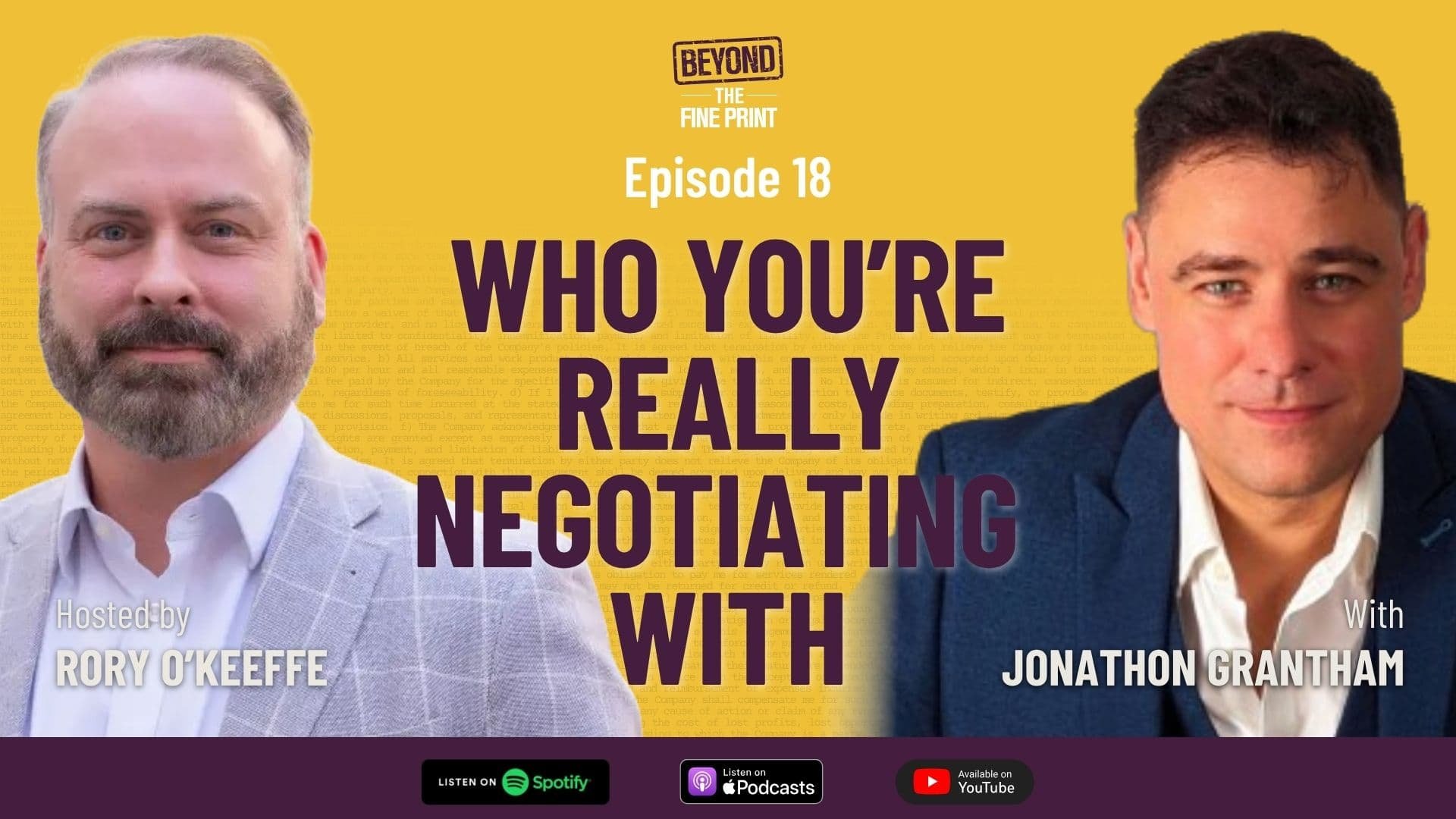
Jonathon Grantham has spent decades inside that game. His book, “The Corporate Sociopath Handbook”, was described by one reviewer as "light, funny, easy to read and slightly sociopathic." He studies corporate sociopaths the way David Attenborough studies predators: fascinated, composed, and safely out of reach.
This episode of Beyond The Fine Print is not a comfortable listen. But it is an extremely useful one, particularly if you are a business leader, a lawyer, a legal lead, or anyone who has sat across the table from someone and thought: I cannot quite work out what is happening here, but something is very wrong.
What Are the Dark Five Traits, and Which Is Most Dangerous Inside a Large Organisation?
The dark five personality traits are narcissism, Machiavellianism, psychopathy (or sociopathy), sadism, and spitefulness. They are highly correlated: if someone scores high on one, they are likely to overlap on others. Jonathan’s research suggests that over 80% of middle managers in large organisations exhibit at least one of these traits.
His answer on which is most dangerous was immediate: the sadist. Sadism and spitefulness, in his view, have no business value. He cannot construct a scenario where a manager who takes pleasure in hurting people or holding grudges adds value to an organisation.
The other three are more nuanced. And this is where the conversation becomes uncomfortable.
Can Machiavellian Traits Actually Be Useful in Business?
Jonathon argues they can. His example: when two senior managers are locked in a silo war, competing for resources and no longer thinking about the company, a skilled Machiavellian player can resolve the situation without anyone realising what happened. One faction gets quietly undermined. The game is over before it starts.
His test for whether a Machiavellian has succeeded is simple: "A Machiavellian has failed if you recognise them as a Machiavellian."
The distinction he draws is between the narcissist, who needs to be recognised as the most important person in the room, and the Machiavellian, who is perfectly content for you to think the room was your idea. The narcissist, he notes, can be identified with a single question: "Are you a narcissist?" This is, apparently, the most accurate diagnostic test available. It recently replaced a 36-question assessment.
How Do Sociopathic Traits Connect to Corporate Structure?
Jonathon’s thesis is that corporations are, by design, sociopathic. As a managing director, his first priority is the shareholder. He is not permitted to redirect company funds to solve social problems unless he can justify it commercially through publicity-driven sales. That entire framework, he argues, requires sociopathic thinking.
His observation on diversity and inclusion programmes was the most provocative part of the conversation. He outlined four reasons why companies pursue diversity initiatives, none of which are the reasons stated in the press release: a more diverse workforce is less likely to unionise and can be paid less; diversity creates process standardisation that facilitates automation and outsourcing; diversity programmes generate marketing value; and meeting ESG quotas drives institutional investment and share price.
His point is not that these programmes are valueless. It is that the stated reasons and the actual drivers rarely align, and that in-house counsel who take the stated reasons at face value may find themselves navigating with an inaccurate map.
What Negotiation Tactics Do Sociopathic Players Actually Use?
The episode covers environmental manipulation in negotiations: controlling room temperature, food deprivation, sleep pressure, and last-minute document changes. I shared my own experience of a counterparty demanding a million off a deal at 4:40 in the afternoon, when everyone needed to catch flights, after months of negotiation that had already cut the margin to the bone.
Jonathon’s instinctive response to that kind of dominance play is to escalate in the opposite direction. "The contract is at 5 million. You have just asked for 1 million off. Let us do 6 million instead." His logic: if it is a dominance game, the only losing move is to retreat. Beat your chest back.
His broader point is that these tactics exist on a spectrum from smart leverage to manipulation, and the line between them is often cultural, contextual, and, if we are honest, largely academic to the person deploying them.
What Should You Do in the Next 48 Hours If You Think You Are in a Viper Pit?
Jonathon’s most practical advice centres on three things.
First, build the paper trail before you need it. He credits Prince2 project management methodology, which he otherwise considers excessive for IT projects, as the single most useful protective framework he has encountered. The principle: low paperwork until something happens, then an established documentation framework appears automatically. As I put it to listeners: it is not cynicism. It is professionalism. It is far cheaper to build before you need it than after.
Second, detach your identity from your ethics. Jonathon argues that many professionals wear their ethical identity as a shield, "I am an ethical person, everyone knows this," and then struggle when asked to do something that challenges that identity. His advice: step back, recognise your bias, and reevaluate the situation logically, preferably outside the office. Often, the problem goes away. When it does not, you are left with three options: comply (and become complicit), leave quietly, or blow the whistle.
Third, name what you are seeing. If you can identify the tactic, the trait, or the pattern, you shift from reacting emotionally to responding strategically. The people who play this game deliberately have one advantage over those who do not: they know it is a game. Once you know that too, you are not a player in any cynical sense. You are simply a more informed professional.
Why Does This Matter for Lawyers and Business Leaders?
The gap between what organisations say they value and what they actually promote is not a values failure. It is a structural one. Understanding the dark five does not make you cynical. It makes you literate in the actual operating system of the organisation you work inside.
Jonathon’s book is worth reading to the end. The first two thirds map the terrain. The final third is the survival guide. Paper trails, speak-up cultures, whistleblower protections, and the practical mechanics of staying alive with your career and your conscience intact.
As I said to listeners: in the movie The Game, Michael Douglas eventually figures out what is happening. Not because he becomes more cynical, but because he finally starts paying attention to what is actually there, rather than what he was told to see.
Key Takeaways
The dark five traits (narcissism, Machiavellianism, psychopathy, sadism, spitefulness) are present in over 80% of middle managers in large organisations.
Sadism and spitefulness have no business value. Machiavellianism and controlled sociopathy can be structurally useful in certain leadership roles.
Corporations are sociopathic by design: shareholder primacy requires sociopathic thinking.
The gap between what organisations say they value and what they reward is structural, not accidental.
Build your paper trail before you need it. It is cheaper, more convincing, and more protective.
Emotional intelligence does not mean thinking emotionally. It means intellectualising empathy without letting emotions drive decisions.
If the stomach feeling persists across multiple situations with the same person, trust it. It is not weakness. It is data.
About the Guest
Jonathon Grantham is the author of The Corporate Sociopath Handbook. He is a managing director of a software company based in Adelaide, Australia, with a background in computer science, corporate consulting, and security. His work focuses on the psychology of corporate behaviour, the dark five personality traits, and the structural dynamics that reward certain behaviours inside large organisations.
About the Host
Rory O’Keeffe is the founder of RMOK Legal, a City of London commercial law practice specialising in AI governance, technology contracts, and fractional general counsel services. He is an SCL-accredited Leading IT Lawyer, AI Committee member of the Society for Computers and Law, and author of AI Advantage: Thriving Within Civilisation’s Next Big Disruption (2025). He previously served as Partner at Matheson and Director of Legal Services at Accenture.
Listen to this episode: Spotify | Apple Podcasts | YouTube
Subscribe to Beyond The Fine Print (newsletter)