

What CEOs Really Think About Legal Risk - And How to Communicate It
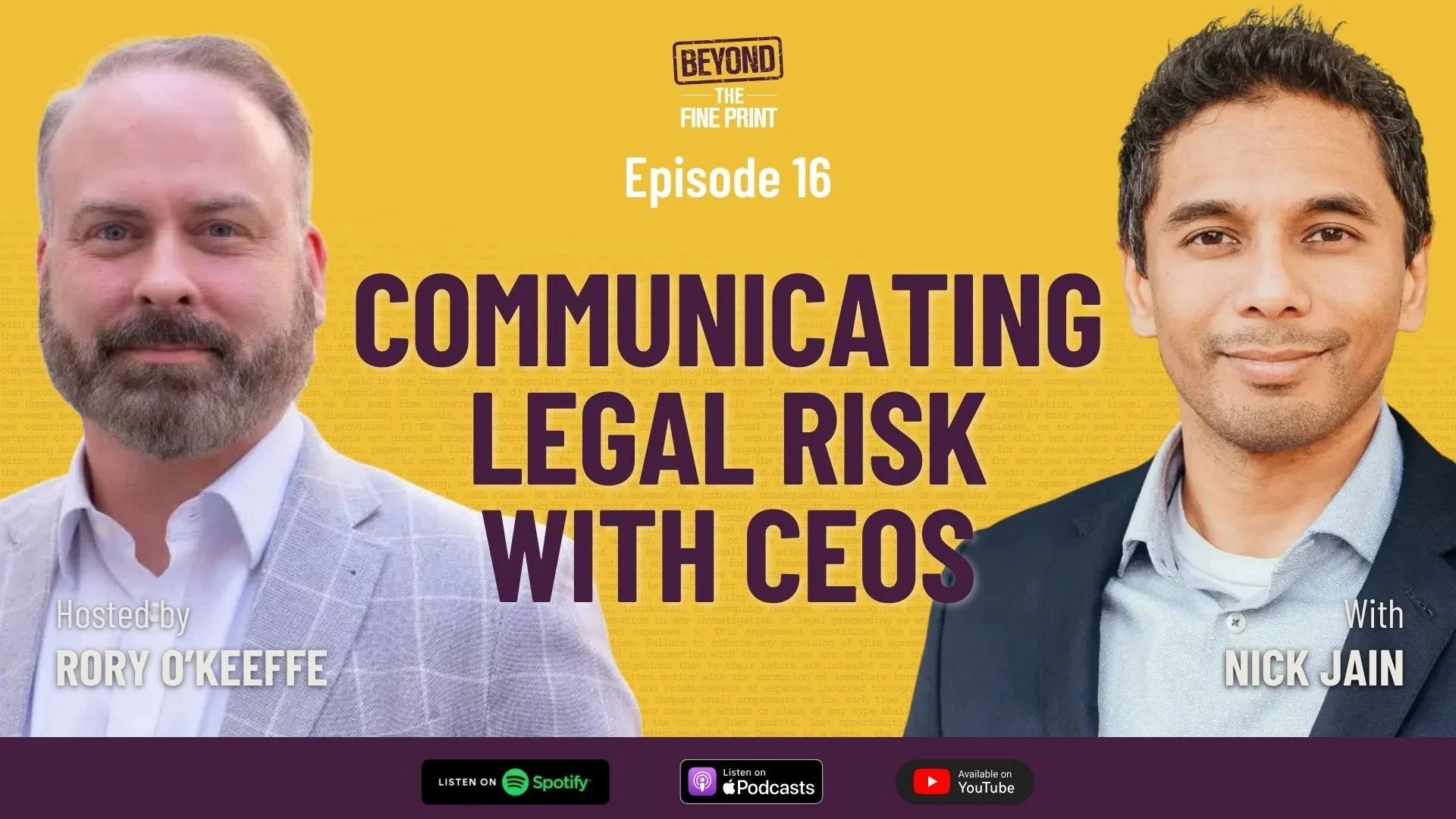
Most lawyers think CEOs want to know everything that could go wrong. They do not. What CEOs and CFOs actually need from legal counsel is two things: the probability that a risk will actually materialise, and whether the legal position will hamstring future business decisions. In this episode of Beyond The Fine Print, Rory O'Keeffe speaks with Nick Jain, a CEO and growth operator, about how executives triage legal risk in practice, what makes legal advice land as strategy rather than noise, and how in-house and fractional general counsel can earn and keep a seat at the leadership table.
Listen on Spotify, Appe Podcasts, Amazon Music or YouTube. Episode runtime: approximately 40 minutes.
〰️
Listen on Spotify, Appe Podcasts, Amazon Music or YouTube. Episode runtime: approximately 40 minutes. 〰️
What do CEOs actually want from their legal team?
According to Nick Jain, executives are not looking for a comprehensive risk catalogue. They want two things delivered clearly and quickly.
The first is probability. Not whether something could go wrong, but how likely it actually is. A theoretical risk that has a one-in-a-billion chance of materialising is not the same as a genuine business exposure, and treating them identically wastes everyone's time and credibility.
The second is optionality. Will this legal position close off future business decisions? The example Nick gave was a software customer contract that would have prevented technology upgrades if they were not backwards compatible - a clause no technology company could reasonably accept, because it would have prevented the business from patching security vulnerabilities. A lawyer who flags that clause as a genuine deal-stopper is doing their job. A lawyer who flags every theoretical risk equally is not.
The shorthand Nick uses: explain it to me like I'm an eight-year-old, or a golden retriever. The reference is to Jeremy Irons' character in Margin Call. The point is not that executives are unsophisticated. It is that clarity is a form of respect for everyone's time - and that legal advice which cannot be communicated simply is legal advice that will not be acted on.
What are the three categories of legal risk that CEOs actually prioritise?
Nick identified a clear framework that executives apply when triaging legal risk - whether formally or intuitively.
Category 1 — Decision optionality
Risks or legal positions that reduce the range of future business decisions available. If a contract clause prevents the business from entering a major market, or locks it into a technology standard it cannot maintain, that is category one. These have to be escalated immediately because the cost is not just immediate - it compounds over time.
Category 2 — Catastrophic and existential risk
Business-ending lawsuits. Risks that are not priced into operating costs and revenues. Every business faces routine HR disputes and customer service issues - those are expected and managed. What is not expected, and cannot be absorbed, is an existential claim. The legal team's job is to draw a clear line between what is course-of-business noise and what is a genuine threat to the organisation's survival.
Category 3 — Unquantifiable risk
Risks where the range of outcomes cannot be bounded. Good executives are continuously running probabilistic cost-benefit analysis - if this goes wrong I lose X, if it goes right I gain Y. When the legal position introduces a risk that cannot be bounded - one where the outcome range is genuinely unknown - that needs to be communicated differently from a quantified risk. Lawyers who treat every risk as unquantifiable are crying wolf. Lawyers who identify genuine unquantifiable risks and communicate them clearly as such are providing strategic value.
How should in-house and fractional counsel communicate with the C-suite?
The communication problem is not usually intelligence or legal knowledge. It is format and framing.
Nick's approach - drawn from a background in theoretical mathematics, where communicating complex proofs simply is essential - is to write everything in bullet points with sentences of eight words or fewer. The goal is to spend the mental effort on clarity yourself, so the executive does not have to spend mental effort reading. When you write simply and clearly, the response is faster, the decision is better, and your credibility goes up.
Rory's framing for this is 'rooftop ready' advice. Take one piece of advice you would normally deliver in paragraphs. Rewrite it as a single business sentence with the decision, the options, and the recommendation. That is the format that lands as strategy rather than static.
The critical distinction Nick draws is between being a partner and being an archivist. An archivist documents what could go wrong and attaches caveats to everything. A partner understands the business model, understands what decisions the CEO is facing, and provides advice calibrated to what actually matters. The partner gets invited back. The archivist gets cc'd on emails.
How do you build credibility with leadership when you are under pressure?
Nick identified two things that consistently build credibility at C-suite level.
The first is understanding how the business makes money. Lawyers who know the P&L, understand the revenue model, and can connect legal risk to financial impact are far more effective than those who operate in a legal silo. This applies equally to in-house counsel and to fractional general counsel - the investment in understanding the business pays back in every conversation.
The second is consistency. Executives remember the lawyer who gave them clear advice that turned out to be right. They also remember the lawyer who covered every possible risk and left them no clearer on what to actually do. Building the habit of clear, calibrated, commercially grounded advice is how you earn the invitation to the meetings where decisions are made - rather than being briefed afterwards.
What does this mean for fractional general counsel specifically?
The fractional GC model is particularly well positioned to operate the way Nick describes, for three reasons.
First, a fractional GC who works across multiple businesses simultaneously develops a calibrated sense of commercial risk that a single-company in-house lawyer may not. They have seen more edge cases, more deal structures, and more negotiations — which makes probability assessment more reliable.
Second, the fractional model creates a natural incentive to be clear and efficient. A fractional GC who consumes excessive time with lengthy qualifications and exhaustive risk catalogues will not retain clients. The commercial pressure of the model aligns with the communication style CEOs actually value.
Third, a fractional GC with genuine AI and technology law specialism - rather than a generalist who has added AI to their service list - can provide the kind of commercially grounded AI governance advice that the C-suite increasingly needs. The EU AI Act, AI contracting obligations and AI governance frameworks require both legal precision and commercial judgment. That combination is rare.
Key takeaways from this episode
CEOs do not want a risk catalogue. They want probability and impact, delivered clearly and quickly.
The three legal risk categories executives actually prioritise: decision optionality, catastrophic risk, and unquantifiable risk. Everything else is noise.
Communicate in the format of a decision memo, not a legal opinion. One sentence. The options. The recommendation.
Understand how the business makes money before you advise on how to protect it. Legal advice that does not connect to commercial reality will not land.
The difference between a partner and an archivist is not knowledge. It is calibration. Partners understand what matters. Archivists document everything equally.
Fractional general counsel who work across multiple businesses tend to develop sharper risk calibration than single-company in-house lawyers, making their advice more commercially useful.
Simplicity is a skill. Writing clearly enough that the reader does not have to spend mental effort is harder than writing with complexity. It is also more effective.
About this episode's guest
Nick Jain is a partner at Eagle Rock and a former CEO of IdeaScale and other high-growth businesses. He is a $100 million-plus growth operator with experience across Wall Street investment and operational leadership. Nick has worked with legal teams ranging from boutique advisers to the largest law firms in the world, and brings a rare perspective on how C-suite executives actually use and evaluate legal advice.
About the host
Rory O'Keeffe is a solicitor regulated by the Solicitors Regulation Authority, former Partner at Matheson and former Director of Legal Services at Accenture. He is the founder of RMOK Legal, an SCL-accredited Leading IT Lawyer, a member of the Society for Computers and Law's AI Committee, and the author of AI Advantage: Thriving Within Civilisation's Next Big Disruption (2025). Beyond The Fine Print is the tech law podcast for in-house counsel and business leaders, covering AI regulation, digital law and commercial legal strategy. Available on Spotify, Apple Podcasts and YouTube.